Physically-Feasible Reactive Synthesis
for Terrain-Adaptive Locomotion

An integrated planning framework for quadrupedal locomotion over dynamically changing, unforeseen terrains

Physically-Feasible Reactive Synthesis for Terrain-Adaptive Locomotion

Ziyi Zhou1, Qian Meng2, Hadas Kress-Gazit2, Ye Zhao1
1Georgia Tech, Atlanta, GA, USA   2Cornell University, Ithaca, NY, USA

Video

Abstract

We present an integrated planning framework for quadrupedal locomotion over discrete, unforeseen terrain configurations revealed at runtime. Existing methods often depend on heuristics for real-time foothold selection—limiting robustness and adaptability—or rely on computationally intensive trajectory optimization across complex terrains and long horizons. In contrast, our approach combines reactive synthesis for generating correct-by-construction symbolic-level controllers with mixed-integer convex programming (MICP) for physically feasible footstep planning during each symbolic transition. To reduce the reliance on costly MICP solves and accommodate specifications that may be violated due to physical infeasibility, we adopt a symbolic repair mechanism that selectively generates only the required symbolic transitions. During execution, real-time MICP replanning based on actual terrain data, runtime symbolic repair, kinematic-feasibility re-targeting, and a delay-aware coordination scheme enable seamless bridging between offline synthesis and online operation. Through extensive simulation and hardware experiments, we validate the framework's ability to identify missing locomotion skills and respond effectively in safety-critical environments, including scattered stepping stones and rebar scenarios.

Approach Summary
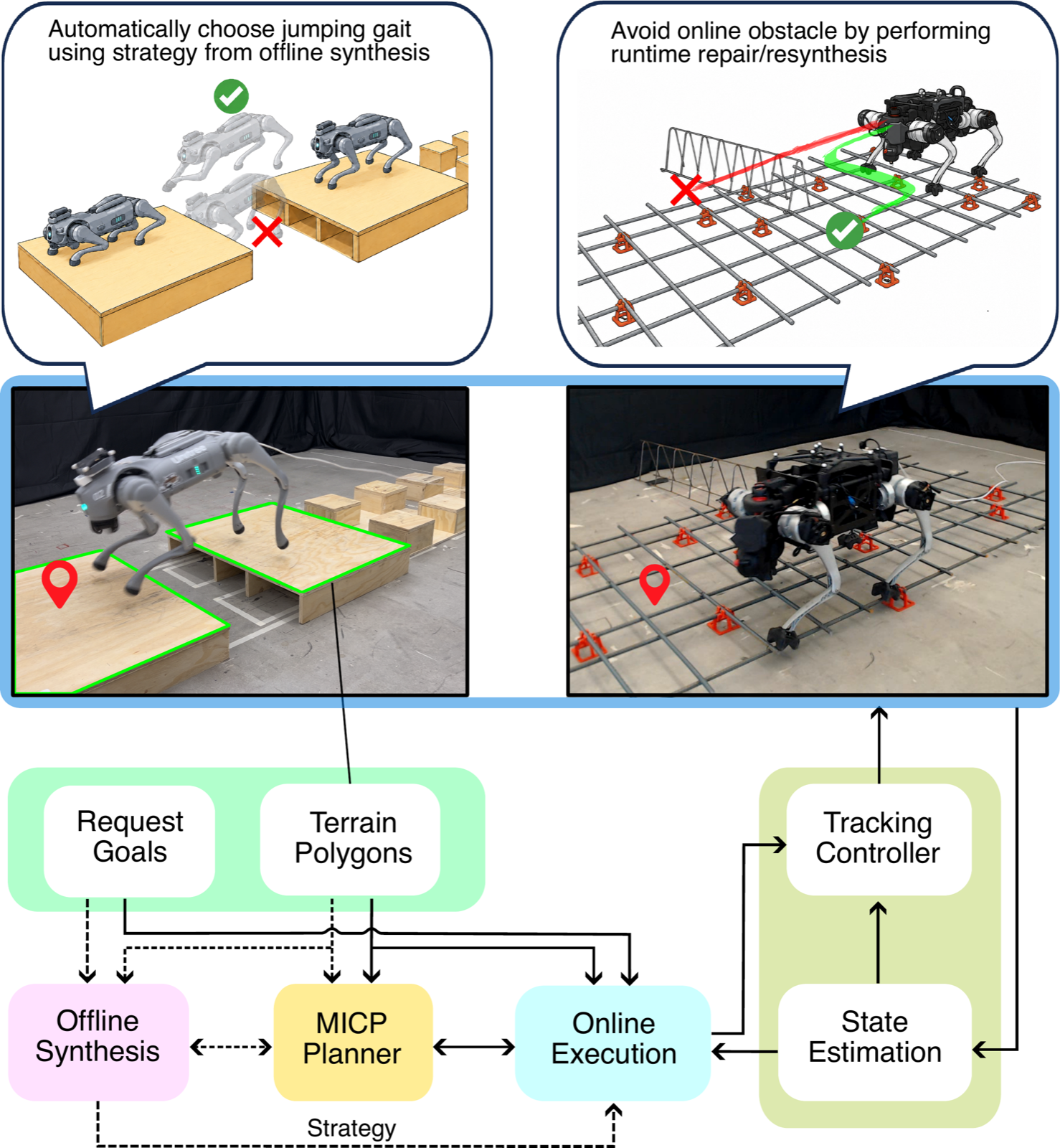
System architecture overview

Fig. 1 System architecture overview. Solid lines indicate online communication; dashed lines represent offline processes. Request goals are user-defined in the offline phase and provided by a global planner in the online phase.

We manage complexity at both the symbolic and physical levels. At the symbolic level, reactive synthesis decomposes local navigation into manageable subproblems whose solutions are reusable across scenarios; each subproblem is a short-horizon symbolic transition. At the physical level, each transition is validated by a mixed-integer convex program (MICP) that certifies dynamic and kinematic feasibility. This symbolic guidance limits the planning horizon and the number of terrain features any single MICP must consider, mitigating the poor scaling of pure mixed-integer planning.

Offline, gait-free MICP precomputes a diverse set of locomotion skills (e.g., trotting and leaping gaits) for predefined terrain states and goals. A high-level manager fixes the local terrain/goal context and retains only the skills relevant to the current environment, while symbolic repair—equipped with dynamic-feasibility checks—generates only the missing transitions that need to be verified. Online, a lightweight gait-fixed MICP is re-solved against the actually perceived terrain at each transition. Runtime symbolic repair handles previously unseen terrain, kinematic-feasibility re-targeting adjusts the desired pose to match real geometry, and a delay-aware coordination scheme keeps the discrete strategy automaton and the continuous-time tracking controller consistent under variable MICP solve times.

Key contributions

  • Integrated reactive-synthesis + MICP framework bridging high-level symbolic reasoning with low-level physical feasibility.
  • Scalable offline synthesis. The high-level manager reduces the symbolic state space by 80.9–90.1%; symbolic repair with gait-free MICP feasibility checks generates only necessary skills, cutting costly gait-free MICP solves by 71.6–97.6% versus exhaustive enumeration.
  • Online execution module with delay-aware coordination, kinematic-feasibility re-targeting, online collision-avoidance constraints, and runtime symbolic repair.
  • Comprehensive validation across four simulated terrain scenarios, benchmarks against pure-MIP and heuristic planners, and hardware deployment on two robots (Unitree Go2 and SkyMul Chotu).
Simulation

Unstructured terrain — 4 terrain types

Unstructured terrain — full 8-type abstraction

Rebar terrain — navigation across rebar mats; green trajectories are detours from runtime re-synthesis after online MICP solving failures

We evaluate the framework across four scenarios spanning two terrain families and two robot platforms (Unitree Go2 and SkyMul Chotu): unstructured terrain abstracted with 4 and 8 terrain types (flat, high/low terrain, dense/sparse stone, gap, high/low gap), and rebar terrain abstracted with 7 and 14 types based on directional rebar sparsity. We test both 3×3 and 5×5 local grid abstractions; the 5×5 grid enables a longer planning horizon at the cost of higher decision complexity. All experiments run on an Intel Core i9-13900K with 64 GB RAM, using Gurobi 9 for the MICP and OCS2 for the NMPC tracker.

Scalable offline synthesis. The high-level manager reduces the symbolic state space by 80.9–90.1%. Symbolic repair resolves 93.4% of all terrain–request state pairs and reduces costly gait-free MICP solves by 71.6–97.6% versus exhaustive enumeration (generating a new gait takes 27.23 s on average, 145.66 s maximum). Repair time grows approximately linearly in the number of state pairs—per state pair, the 5×5 grid takes 478.1% more time than the 3×3 grid.

Online execution. The gait-fixed MICP averages about 430 ms on unstructured terrain and 1.1 s on rebar terrain; enabling collision-avoidance constraints (needed for elevation changes) raises the binary-variable count by 271% and the solve time by 441%.

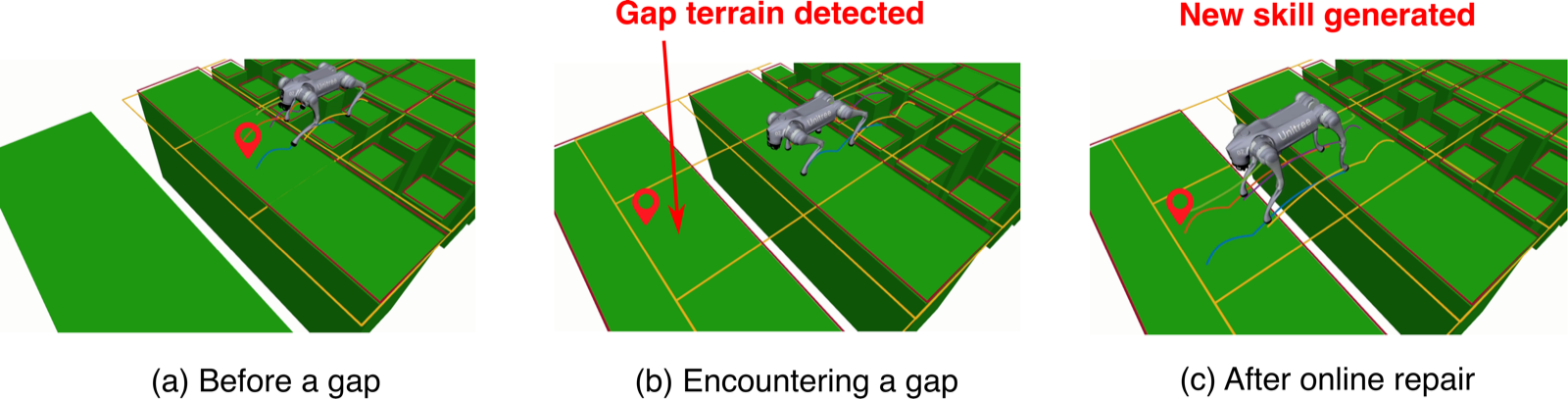
Runtime symbolic repair for an unforeseen gap

Runtime repair case study. When the robot meets an unforeseen gap deliberately excluded from offline synthesis, runtime repair proposes the missing transition and gait-free MICP synthesizes a leaping skill in 12.36 s total (0.18 s symbolic repair + 12.18 s MICP)—confirming the dominant cost is the dynamic-feasibility check, not the symbolic search. Online MICP solving failures trigger fast re-synthesis (0.07–0.11 s) that routes a detour using existing skills.

Hardware — Unstructured Terrain

We deploy the full stack end-to-end on hardware. Stepping stones, gaps, and flat regions are built from wooden blocks (each stone ~0.12 m tall); the abstraction cell size is 0.8 m.

Scenario 1 — Side view

Scenario 1 — Front view

Scenario 1 — misaligned stepping stones. Sparse stones (0.18–0.23 m apart) are laterally misaligned with the walking direction, so the online MICP plans a sideways trajectory to land safely; all transitions use a 3 s trotting gait.

Scenario 2 — Stepping stones with a gap

Scenario 2 — crossing a gap. A ~30 cm gap requires leaping. Since the gap was covered in offline synthesis, the framework directly selects an optimized 1.5 s leaping gait; end-effector tracking stays within 0.01 m (x, y) as the NMPC absorbs MICP-level model simplifications.

Hardware — Rebar Terrain

The SkyMul Chotu (a modified Unitree Go1 with a rebar gun and “cross”-shaped feet) traverses a rebar mat with 0.1–0.3 m spacing. All transitions use a conservative 2.25 s static walking gait (one foot at a time); the abstraction cell size is 0.45 m.

Scenario 1 — Nominal traversal

Scenario 2 — Runtime obstacle detour

Scenario 1 — nominal traversal. With no obstacles, Chotu completes the maneuver to the goal without any runtime failures.

Scenario 2 — runtime obstacle detour. An obstacle is added but seen only at runtime (provided via motion-capture-aided annotation and handled at the symbolic level, not the MICP). On detecting the new terrain/request pair, the planner resynthesizes a detour within 0.05 s, reusing existing skills.

Benchmark

We benchmark the symbolic–continuous separation against a pure-MIP planner (an ablation of the symbolic level) and a heuristic foothold planner.

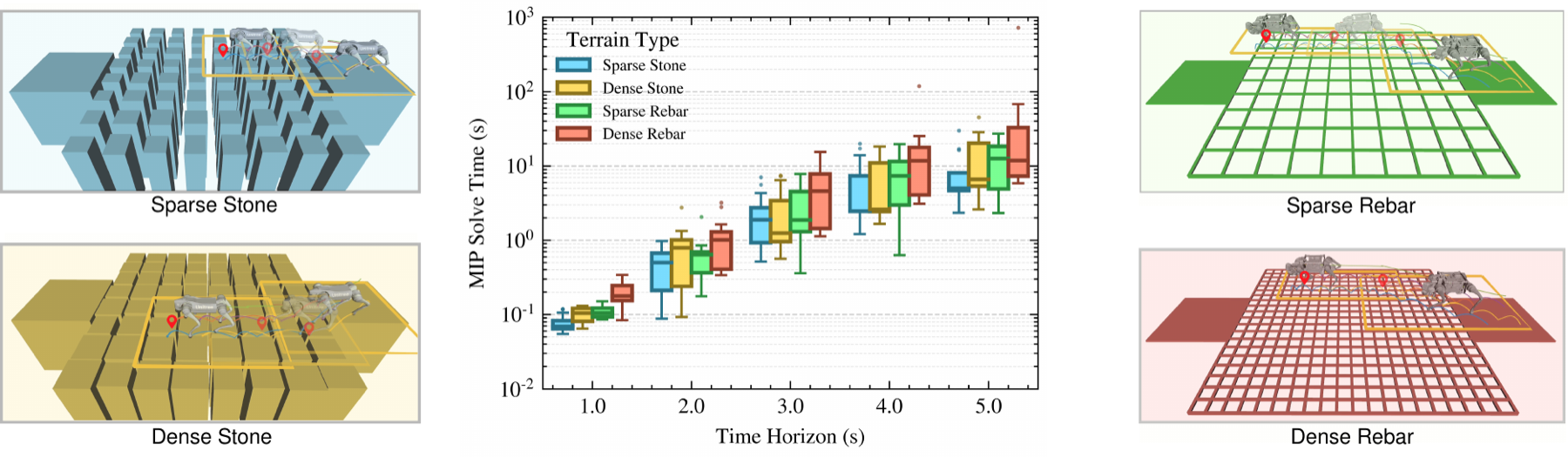
Pure-MIP solve time across terrains and horizons

MIP solve time across four terrains (sparse/dense stone, sparse/dense rebar) and horizons of 1–5 s, as box plots over 10 seeded waypoints per scenario. Solve time grows almost exponentially with the horizon, and denser terrains take longer; the 2 s and 3 s horizons sit on the knee of the trade-off curve.

Sparse stone — horizon H = 1 s

Dense stone — horizon H = 2 s

Sparse rebar — horizon H = 4 s

Dense rebar — horizon H = 5 s

Representative pure-MIP traversals corresponding to the snapshots overlaid in the figure above (one terrain/horizon each).

Dense rebar comparison

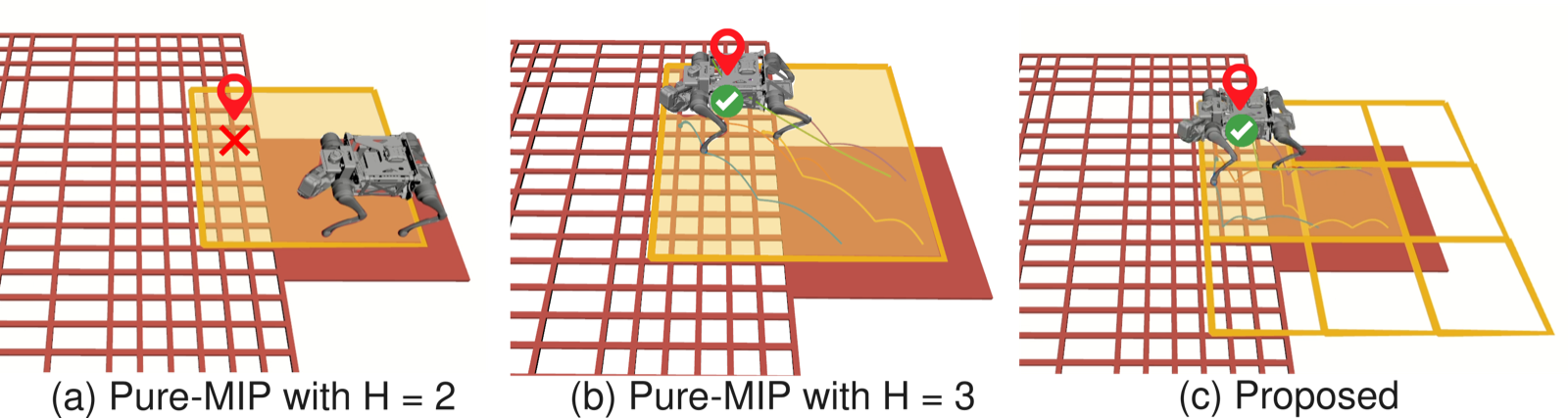
Representative dense-rebar trial: (a) pure-MIP with H = 2 s stalls, (b) pure-MIP with H = 3 s, (c) the proposed planner routes through a sequence of cells.

In the end-to-end dense-rebar test (10 seeded waypoints, identical terrain across methods with randomly removed rebars), the proposed planner attains 90% success at 18.5 s mean traversal—matching the 3 s-horizon pure-MIP success rate at roughly three-quarters of the traversal time and less than half the MIP transition cost (5.26 s vs. 11.54 s). The myopic 2 s-horizon pure-MIP reaches only 60%.

The ablations confirm the value of the online additions: disabling the feasibility check (FC) drops success substantially, and disabling delay-aware coordination (DAC) keeps 90% success but inflates traversal time from 18.5 s to 23.4 s.

End-to-end benchmark on dense rebar

Method Success Traversal (s) MIP solve (s) MIP feas. (s) Reactive synth. (s) Runtime repair (s)
Pure MIP (H = 2 s)60% (6/10)14.763.040.21
Pure MIP (H = 3 s)90% (9/10)24.7311.540.19
Pure MIP (H = 2 s), no FC20% (2/10)9.001.38
Pure MIP (H = 3 s), no FC40% (4/10)14.235.17
Proposed90% (9/10)18.485.260.190.290.03
Proposed, no FC60% (6/10)20.085.850.330.05
Proposed, no DAC90% (9/10)23.435.110.270.280.04

Mean values over successful trials. FC = pre-flight MIP feasibility check; DAC = delay-aware coordination; reactive synthesis combines the per-step strategy query and per-spec-switch strategy reload. Dashes denote modules absent or disabled by the ablation.

Hardware: vs. a heuristic foothold planner (Scenario 3)

On extreme-sparse rebar (up to 0.48 m spacing), our planner classifies the region as an obstacle and resynthesizes a safe detour, while a nearest-feasible-foothold heuristic slips and gets trapped once run at our matched 0.2 m/s gait speed.

Proposed — resynthesizes a detour around the extreme-sparse region and reaches the goal

Heuristic baseline — 0.1 m/s (heuristic's tuned slow speed)

Heuristic baseline — 0.2 m/s (matched to our gait speed): foot slippage and failure